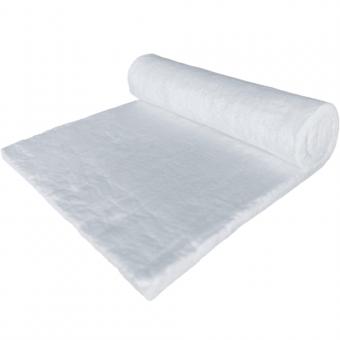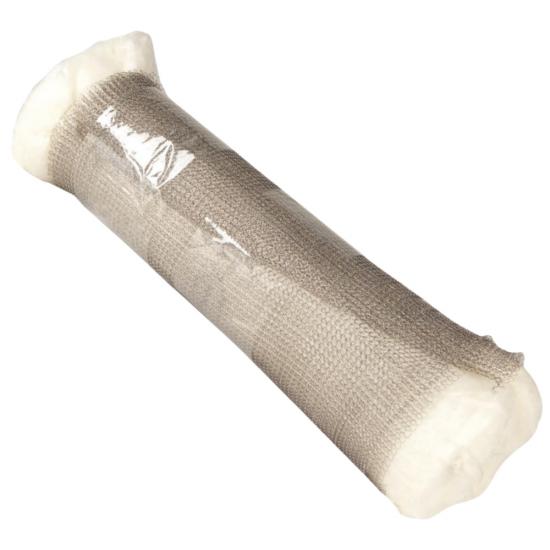


BSTFLEX ceramic fiber blanket is a lightweight, flexible high temperature insulation material manufactured from spun ceramic fibers and mechanically needled to form a strong, stable blanket structure. It is designed for thermal insulation applications where low heat storage, low thermal conductivity and resistance to repeated high-temperature exposure are required.
Depending on the required temperature class, different ceramic fiber compositions are available, including aluminosilicate fiber and zirconia-containing high-temperature grades. Classification temperatures are available up to 1430°C depending on the selected material grade.
The blanket can be supplied in different thicknesses, densities, widths and roll formats for use in furnaces, kilns, boilers, exhaust systems, thermal equipment, heat shields and fabricated insulation assemblies.
What Is Ceramic Fiber Blanket?
Ceramic fiber blanket, also commonly searched as ceramic wool blanket, refractory ceramic fiber blanket or ceramic fiber insulation blanket, is produced by forming high-temperature ceramic fibers into a flexible mat and mechanically interlocking the fibers through a needle-punching process.
Unlike rigid refractory insulation, the resulting material remains flexible and can be cut, wrapped, layered or fabricated around equipment and complex surfaces. The needled structure also improves handling strength and helps the blanket maintain its integrity during installation.
The material is particularly useful where insulation must tolerate rapid temperature changes without the cracking or thermal-shock problems associated with some rigid refractory materials.
Key Features
- High temperature classification up to 1430°C, depending on grade
- Low thermal conductivity for reduced heat transfer
- Low heat storage compared with many dense refractory materials
- Flexible needled construction
- Good resistance to thermal shock
- Lightweight and easy to cut or fabricate
- Good handling strength for installation and assembly
- Available in different densities and thicknesses
- Suitable for multilayer thermal insulation systems
- Can be supplied in rolls or converted to application-specific dimensions
Ceramic Fiber Blanket Specifications
| Product | Ceramic Fiber Blanket |
| Construction | Mechanically needled ceramic fiber blanket |
| Fiber Type | Aluminosilicate ceramic fiber; selected high-temperature grades may contain zirconia |
| Classification Temperature | Up to 1430°C depending on grade |
| Available Density | 96 kg/m³ and 128 kg/m³ options according to grade and specification |
| Standard Width | 610 mm and 1220 mm |
| Available Thickness | 10, 20, 25, 30, 40 and 50 mm |
| Roll Length | Varies according to thickness, density and required specification |
| Supply Form | Rolls, cut lengths and custom converted insulation components |
| Packaging | Bag or carton according to product size and order requirements |
Important: Classification temperature should not automatically be treated as the recommended continuous operating temperature. The correct ceramic fiber grade must be selected according to actual hot-face temperature, exposure time, atmosphere, mechanical loading and insulation design. Contact BSTFLEX for grade-specific technical data before final specification.
Available Ceramic Fiber Blanket Grades
Ceramic fiber blankets can be produced in several temperature and fiber-composition grades. The correct grade depends on the temperature profile and operating conditions of the equipment.
Standard Ceramic Fiber Blanket
Standard aluminosilicate ceramic fiber blanket is suitable for general high-temperature insulation applications where a flexible refractory insulation layer is required.
High Purity Ceramic Fiber Blanket
High-purity grades are selected for applications requiring controlled fiber chemistry and reliable thermal performance under elevated-temperature service.
High Temperature and Zirconia Grades
For more demanding thermal environments, higher-temperature ceramic fiber compositions, including zirconia-containing grades, can be supplied. These materials are intended for applications where the required temperature capability exceeds that of standard ceramic fiber blanket.
The required classification temperature should be specified when requesting a quotation.
Why Needle Punching Matters
The fibers inside a ceramic fiber blanket are mechanically interlocked by needle punching. This produces a three-dimensional fiber structure without relying on a woven construction.
The needling process provides several practical advantages:
- Improved blanket handling strength
- Better resistance to separation during cutting and installation
- Flexible conformance around curved equipment
- Stable thickness for multilayer insulation assemblies
- Easy fabrication into strips, pads and custom shapes
Thermal Insulation Performance
Ceramic fiber blanket combines low density with low thermal conductivity, allowing useful thermal resistance without the weight of many traditional refractory insulation materials.
Its low heat storage is particularly useful in equipment that experiences frequent heating and cooling cycles. Less thermal mass can reduce the amount of energy absorbed by the insulation during startup compared with dense refractory materials.
Actual thermal conductivity varies with temperature, blanket density, fiber grade and compression. Thermal conductivity data should therefore be evaluated at the expected mean temperature rather than by using a single room-temperature value.
Typical Applications
Industrial Furnaces and Kilns
Ceramic fiber blanket is widely used as furnace and kiln insulation, backup insulation, door insulation and thermal barrier material. Its flexibility allows it to follow curved or irregular equipment surfaces.
Boilers and Thermal Processing Equipment
The blanket can be used around boilers, heating equipment, process vessels and other high-temperature machinery where heat loss must be controlled.
High Temperature Pipe and Duct Insulation
Flexible ceramic blanket can be wrapped or incorporated into fabricated systems for high-temperature pipes, ducts and process lines.
Exhaust System Thermal Insulation
Ceramic fiber blanket can be used as an internal insulation layer in properly engineered exhaust heat shields, exhaust insulation assemblies and high-temperature thermal barriers.
Removable Insulation Systems
Where the insulation system design is compatible with ceramic fiber, the blanket may be used as an insulating core inside fabricated removable covers and thermal jackets.
Power Generation Equipment
Potential applications include turbines, boilers, hot piping and other equipment used in power-generation and thermal-processing systems.
Ceramic Fiber Blanket for Exhaust and Heat Shield Fabrication
For OEM heat-management projects, ceramic fiber blanket can be combined with suitable metallic or textile outer layers to form fabricated thermal barriers.
Examples include:
- Exhaust pipe heat shields
- Muffler and silencer insulation
- Industrial exhaust insulation
- Metal-clad thermal insulation
- Removable high-temperature covers
- Custom die-cut or fabricated insulation pads
The selected outer layer, blanket density, thickness and attachment method should be matched to the operating temperature, vibration level and environmental exposure of the finished assembly.
How to Select Ceramic Fiber Blanket
Temperature rating alone is not enough to specify a ceramic fiber insulation blanket. For OEM and industrial purchasing, the following information should be reviewed.
1. Maximum Operating Temperature
Provide both normal operating temperature and maximum short-term exposure temperature. This allows the appropriate fiber grade to be selected.
2. Blanket Thickness
Available thicknesses include 10, 20, 25, 30, 40 and 50 mm. Multiple layers may also be used when the insulation design requires greater total thickness.
3. Density
Density affects handling, compression characteristics and thermal performance. Current BSTFLEX options include 96 kg/m³ and 128 kg/m³ depending on grade and specification.
4. Width and Roll Format
Standard widths include 610 mm and 1220 mm. Roll length depends on thickness and required configuration.
5. Application Environment
Tell us whether the blanket will be used inside a furnace, behind metal shielding, around exhaust equipment, inside a removable insulation cover or in another thermal assembly.
6. Chemical Exposure
Ceramic fiber materials have good resistance to many industrial environments, but compatibility should be evaluated where strong acids, alkalis or other aggressive chemicals are present.
7. Fabrication Requirements
If the material will be cut, laminated, wrapped, encapsulated or incorporated into a finished heat shield, provide drawings or samples whenever possible.
Ceramic Fiber Blanket vs Other Needle Insulation Materials
BSTFLEX supplies several types of flexible high-temperature insulation. The correct material depends on the required temperature range, handling characteristics and finished assembly.
| Material | Typical Selection Reason |
| Ceramic Fiber Blanket | High-temperature refractory insulation and low heat storage |
| Silica Fiber Needle Felt | Flexible silica-based thermal insulation for high-temperature applications |
| Fiberglass Needle Felt | General thermal and acoustic insulation at lower service temperatures |
| Basalt Needle Felt | Mineral-fiber insulation for thermal and acoustic applications |
See the complete needle insulation blanket range for additional material options.
Custom Ceramic Fiber Blanket Supply
BSTFLEX supports OEM, industrial and distribution customers requiring ceramic fiber blanket in different grades and dimensions.
Custom supply options can include:
- Different blanket thicknesses
- Different densities
- Custom widths
- Cut lengths
- Application-specific dimensions
- Custom packaging
- OEM bulk supply
- Converted insulation components
For fabricated thermal insulation projects, customers can provide drawings, dimensions, samples or application information for review.
Information to Include With Your RFQ
To obtain an accurate ceramic fiber blanket quotation, provide as much of the following information as possible:
- Required classification or operating temperature
- Thickness
- Density
- Width
- Roll length or required cut size
- Quantity
- Application
- Hot-face and ambient temperature if known
- Any metal foil, fabric or other facing requirement
- Packaging requirement
- Drawing or sample for converted parts
Frequently Asked Questions
What is ceramic fiber blanket used for?
Ceramic fiber blanket is used for high-temperature thermal insulation in furnaces, kilns, boilers, pipes, ducts, exhaust equipment, heat shields and other thermal-processing systems.
Is ceramic fiber blanket the same as ceramic wool blanket?
In industrial purchasing and online searches, ceramic wool blanket is commonly used as an alternative term for ceramic fiber blanket. Product composition and temperature grade should still be confirmed from the supplier's technical data.
What temperature can ceramic fiber blanket withstand?
BSTFLEX supplies ceramic fiber blanket grades with classification temperatures up to 1430°C. Classification temperature is not necessarily the same as recommended continuous operating temperature, so actual service conditions should be reviewed before selecting a grade.
What thicknesses are available?
Current thickness options include 10, 20, 25, 30, 40 and 50 mm. Custom configurations can be discussed for OEM requirements.
What densities are available?
Current published density options include 96 kg/m³ and 128 kg/m³ depending on the ceramic fiber grade and required specification.
Can ceramic fiber blanket be cut to size?
Yes. The flexible needled material can be cut and converted into strips, pads and other shapes. Provide the required dimensions or drawing for custom fabrication.
Can it be used inside an exhaust heat shield?
Yes, ceramic fiber blanket can be considered as an insulating core in appropriately designed exhaust thermal barriers and metal heat shields. The complete assembly must be selected according to temperature, vibration, mechanical retention and environmental conditions.
Can BSTFLEX supply OEM ceramic fiber blanket?
Yes. BSTFLEX supports bulk and OEM requirements including different thicknesses, densities, dimensions, converted parts and packaging configurations.
Request Ceramic Fiber Blanket Pricing and Technical Data
For ceramic fiber blanket pricing, samples or technical selection support, send BSTFLEX your required temperature, thickness, density, width, quantity and application. For custom thermal insulation components, drawings or samples can also be reviewed for manufacturing feasibility.
BSTFLEX supplies high-temperature insulation materials for OEM, industrial, automotive, exhaust and thermal-management applications worldwide.