other
  • Q: Can I have an sample?
  • A:

    Can I request a sample?

    Yes. We can provide small samples for evaluation. To ensure you receive the correct construction, please include your application details (temperature, exposure type, and dimensions) when requesting samples.

    What information should I provide?

    • Product family you are considering (fire sleeve, heat shield tape/barrier, exhaust insulation, welding protection)
    • Temperature range (continuous and peak)
    • Exposure type (radiant heat, contact heat, flame/sparks, abrasion, fluids)
    • Size requirements (hose OD/ID, width/length, thickness limits)
    • Target quantity and delivery timeline (for quotation planning)

    Recommended starting points

    Next Step: Send your sample request with application details for a faster recommendation.

    Request a Quote / Sample | Download Technical Documents

  • Q: How do you cut a hose sleeve?
  • A:

    How do you cut a hose sleeve?

    For most sleeves, sharp scissors or a utility knife works. For cleaner edges and reduced fraying on certain textiles, a hot knife is recommended. Always follow your site safety procedures.

    Common cutting methods

    • Scissors/utility knife: quick cuts for many sleeve types
    • Hot knife: helps seal edges and reduce fraying for some constructions
    • Cut-to-length service: for production programs requiring repeatability

    If you need cut-to-length, special packaging, or labeling, see: Custom Capabilities.

    For product datasheets, visit: Downloads.

  • Q: How do I size a sleeve properly to fit the hose?
  • A:

    How do I size a sleeve properly to fit the hose?

    Size selection should be based on the hose/bundle outside diameter plus allowance for movement, bend radius, and installation method. A sleeve that is too tight can restrict hose movement and increase wear at routing points.

    Quick sizing steps

    • Measure hose/bundle O.D. at the installation location.
    • Add allowance if the hose flexes or moves during operation.
    • Consider routing constraints: clamps, brackets, corners, and nearby heat sources.

    When to oversize

    • High vibration or frequent movement
    • Complex bends or tight routing
    • Installation requires sliding over fittings or connectors

    If your application includes heat/flame exposure near exhaust routing, start with: Fire Sleeve and review: Quality Guarantee.

    Send sizing details for confirmation.

  • Q: What is the difference between inner diameter (I.D.) and outer diameter (O.D.)?
  • A:

    Inner Diameter vs Outer Diameter (I.D. vs O.D.) for Hose & Sleeve Sizing

    Summary: Understand the difference between I.D. and O.D., how to measure hoses and bundles, and how to select sleeve I.D. using practical oversize rules. Includes circumference-to-diameter formula, an RFQ-ready sizing checklist, and installation tips.

    Related Product Families

    Hose and cable protection near heat/flame: Fire Sleeve | Localized hot spot shielding: Heat Shield Tape | Turbo/exhaust heat management: Exhaust Insulation Solutions | Technical PDFs: Download Technical Documents


    Definitions (fast and practical)

    • I.D. (Inner Diameter): the measurement across the inside opening of a tube or sleeve.
    • O.D. (Outer Diameter): the measurement across the outside of a tube, hose, or sleeve.
    • Key sizing rule: for protective sleeving, sizing usually starts from the hose or bundle O.D. (installation diameter), not the hose I.D. (flow diameter).

    Visual diagram (I.D. vs O.D.)

    This diagram explains I.D. and O.D. at a glance. For most sleeving applications, remember: Sleeve sizing uses hose I.D.
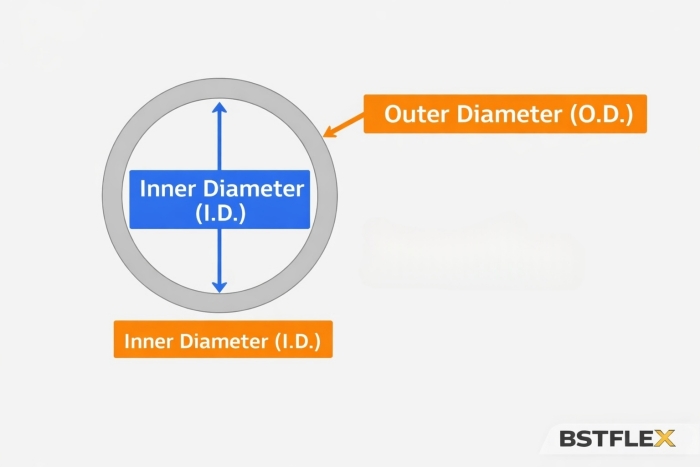
    ID OD of sleeve

    If your hose is routed close to hot exhaust components, correct sizing is only one part of reliability. Consider reducing heat at the source using exhaust insulation solutions, then protect hoses/wiring with fire sleeve protection.


    How to measure correctly (recommended method)

    1. Measure hose/bundle O.D. where the protection is needed (calipers are best).
    2. Check the maximum diameter you must pass over (fittings/connectors are often larger than the hose body).
    3. Confirm movement and vibration: if the hose flexes, allow additional clearance to avoid abrasion.
    4. Confirm heat exposure type: radiant heat vs contact heat vs flame/sparks.

    Mini sizing calculator (text-only)

    Use the formulas below to convert measurements and select an appropriate sleeve size for hoses and bundles. This is a practical engineering reference for quick sizing checks.

    1) Circumference → Diameter

    If you can only measure circumference (C), convert it to diameter (D):

    • D = C ÷ 3.14
    • Use the same unit for C and D (mm or inch).

    Example: C = 160 mm → D ≈ 160 ÷ 3.14 ≈ 51 mm.

    2) Bundle O.D. → Sleeve I.D. selection rule

    Sleeves are typically specified by sleeve I.D., but selection should start from the hose/bundle O.D.. Use these quick guidelines:

    • Stable routing (minimal movement): sleeve I.D. ≈ bundle O.D. + 5–10%
    • Normal movement/vibration: sleeve I.D. ≈ bundle O.D. + 10–20%
    • Installed over fittings: sleeve I.D. must fit the largest O.D. you need to pass over

    Example: Bundle O.D. = 50 mm.

    • Stable routing: sleeve I.D. around 53–55 mm
    • Movement/vibration: sleeve I.D. around 55–60 mm

    Sizing checklist (RFQ ready)

    To confirm sleeve size quickly and avoid back-and-forth, you can copy the checklist below into your RFQ. If you can provide photos of the routing area, we can verify clearance, contact risk, and fastening points.

    Copy/paste checklist

    • Hose / bundle O.D.: ____ mm / ____ inch (measured at protection point)
    • Length to protect: ____ mm / ____ inch (include any overlap requirement)
    • Heat type: Radiant / Contact / Flame / Sparks (select all that apply)
    • Movement: Low (fixed) / Medium (normal vibration) / High (flexing or frequent motion)
    • Clearance to heat source: ____ mm / ____ inch (minimum distance in operation)
    • Quantity: ____ pcs or ____ meters/feet (and target delivery date if needed)

    If the routing is close to turbo or exhaust components, we often recommend a combined solution: reduce heat at the source using exhaust insulation solutions, then protect hoses/wiring with fire sleeve. For localized edge protection and reinforcement, consider heat shield tapes and barriers.


    Common sizing mistakes (and how to avoid them)

    • Mistake: choosing sleeve size based on hose I.D. (flow diameter). Fix: size from hose/bundle O.D.
    • Mistake: ignoring fittings and connectors. Fix: confirm the largest O.D. you must pass over.
    • Mistake: choosing too tight in vibration zones. Fix: allow 10–20% for movement.
    • Mistake: ignoring abrasion at brackets/clamps. Fix: secure sleeves and reinforce points using heat shield tapes and barriers.

    FAQ

    What is I.D. (Inner Diameter)?

    I.D. is the measurement across the inside opening of a tube or sleeve. It describes the internal clearance available inside the product.

    What is O.D. (Outer Diameter)?

    O.D. is the measurement across the outside of a tube, hose, or sleeve. For protective sleeving, the hose/bundle O.D. is usually the key sizing reference because it reflects the installed diameter.

    Do I size sleeves by hose I.D. or O.D.?

    In most cases, size sleeves based on the hose or bundle O.D. (installation diameter), not the hose I.D. (flow diameter). Choose sleeve I.D. that fits comfortably and allow extra clearance for movement and for passing over fittings.

    How do I convert circumference to diameter?

    Use D = C ÷ 3.14. Example: C = 160 mm → D ≈ 51 mm. Keep units consistent (mm or inch).


    Need help confirming sleeve size?

    Send your hose/bundle O.D., routing constraints, temperature range, and exposure type. We will confirm sleeve sizing and recommend the appropriate product family.

    Request a Quote Download Technical Documents

  • Q: Location
  • A:

    Location

    BSTFLEX is the brand of Ningguo BST Thermal Products Co., Ltd. For quotations, samples, technical documents, or program support, please contact our team through the website inquiry form.

    Learn more: Our Company | Quality Guarantee | Contact

  • Q: Pricing and Quotations
  • A:

    Pricing and Quotations

    Pricing depends on product construction, size, quantity, and program requirements. To provide an accurate quotation quickly, we normally confirm the factors below.

    Key factors that affect price

    • Product family and construction: e.g., fire sleeve, heat shield tape/barrier, exhaust insulation, welding protection; material type and layer structure.
    • Size and specification: inside diameter (I.D.) or width, thickness, length per piece/roll, tolerance requirements.
    • Temperature and exposure conditions: radiant vs contact heat, peak vs continuous temperature, abrasion intensity, and any fluid/oil exposure.
    • Quantity and order pattern: trial/sample quantity vs production volume, annual forecast, repeat order frequency.
    • Customization and finishing: cut-to-length, die-cut shapes, stitching/seaming, adhesive backing, edge sealing, or wrap-around formats.
    • Documentation and inspection: CoC, inspection report, batch traceability labeling, and any required sampling plan (AQL) or customer formats.
    • Packaging and logistics: individual packing, labeling, carton marking, palletization, shipping method, and destination.

    Fast RFQ checklist (send these to get a quick quote)

    • Product link (or product family) and intended application
    • Dimensions: hose/bundle O.D. and required sleeve I.D. (or width/length/thickness); drawings if available
    • Temperature rating: continuous and peak; radiant vs contact heat exposure
    • Environment: abrasion level, vibration, oil/fuel/coolant exposure, outdoor exposure
    • Quantity: sample/trial quantity and production volume; target annual demand if known
    • Delivery requirement: target delivery date, destination country/city, preferred shipping method/Incoterms
    • Required documents: CoC, inspection report, SDS/MSDS, RoHS/REACH declarations (as applicable)

    Typical response time & quote validity

    • Typical response time: We usually respond within 24–48 hours on business days after receiving complete RFQ details.
    • Quote validity: Standard quotations are typically valid for 30 days, subject to raw material changes, specification updates, and requested documentation/inspection scope.
    • Fast-track option: If your request is urgent, mark the subject with “URGENT RFQ” and include your target delivery date and priority items.

    For faster product selection, you may start from these categories: Fire Sleeve | Heat Shield Tapes & Barriers | Exhaust Insulation Solutions | Welding Protection

    Ready for a quotation? Send the RFQ checklist above and we will respond with a recommended construction, pricing, MOQ, and lead time.

    Request a Quote Download Technical Documents

  • Q: Delivery and Shipping
  • A:

    Delivery and shipping

    We support international shipping via express, air freight, and sea freight depending on urgency, destination, and order volume. Shipping method selection should balance lead time, cost, and packaging requirements.

    What we need to quote shipping

    • Destination country/city and postal code
    • Order quantity and packing format
    • Preferred shipping method (express/air/sea) or required Incoterms
    • Target delivery date

    For faster processing, include required documents (CoC, inspection report) in your RFQ: Request a Quote.

  • Q: Temperature Conversion Table
  • A:

    Temperature conversion reference

    This page provides a temperature unit conversion reference (°C/°F/K). For engineering decisions and product selection, always follow the product datasheet temperature ratings and your validated measurement method.

    For technical PDFs, visit: Download Technical Documents.


    From

    To Fahrenheit

    To Celsius

    To Kelvin
    Fahrenheit (F) F (F – 32) * 5/9 (F – 32) * 5/9 + 273.15
    Celsius (C or o) (C * 9/5) + 32 C C + 273.15
    Kelvin (K) (K – 273.15) * 9/5 + 32 K – 273.15 K

    Here’s a conversion table that will show you those calculations i Fahrenheit, Celsius and Kelvin.

    Fahrenheit Celsius Kelvin
    -100 -73 200
    -50 -46 228
    0 -18 255
    2 -17 256
    4 -16 258
    6 -14 259
    8 -13 260
    10 -12 261
    12 -11 262
    14 -10 263
    16 -9 264
    18 -8 265
    20 -7 266
    22 -6 268
    24 -4 269
    26 -3 270
    28 -2 271
    30 -1 272
    32 0 273
    34 1 274
    36 2 275
    38 3 276
    40 4 278
    42 6 279
    44 7 280
    46 8 281
    48 9 282
    50 10 283
    52 11 284
    54 12 285
    56 13 286
    58 14 288
    60 16 289
    62 17 290
    64 18 291
    66 19 292
    68 20 293
    70 21 294
    72 22 295
    74 23 296
    76 24 298
    78 26 299
    80 27 300
    82 28 301
    84 29 302
    86 30 303
    88 31 304
    90 32 305
    92 33 306
    94 34 308
    96 36 309
    98 37 310
    100 38 311
    110 43 316
    120 49 322
    130 54 328
    140 60 333
    150 66 339
    160 71 344
    170 77 350
    180 82 355
    190 88 361
    200 93 366
    250 121 394
    300 149 422
    350 177 450
    400 204 478
    450 232 505
    500 260 533
  • Q: Become a Distributor
  • A:

    Become a distributor

    We welcome distribution partners who can provide professional technical support, stable service standards, and long-term market commitment for thermal protection products.

    What we look for

    • Defined target market and customer segment (industrial/OEM/aftermarket)
    • Technical capability to support selection and installation
    • Service and response standards aligned with B2B procurement expectations
    • Commitment to compliant marketing and brand positioning

    Please introduce your company, target market, and product focus. Contact us here: Contact.

  • Q: What documents can you provide (CoC, inspection report, SDS/MSDS)?
  • A:

    What documents can you provide (CoC, inspection report, SDS/MSDS)?

    BSTFLEX supports a practical set of quality and compliance documents for engineering approval, vendor qualification, and incoming inspection. Document availability depends on product family and program requirements. If you have a vendor approval checklist, include it with your RFQ so we can confirm the exact document package. For our process overview, see Quality Guarantee.

    1) Certificate of Conformity (CoC)

    A Certificate of Conformity confirms that supplied goods conform to the agreed specification for the order. CoC is typically issued on request and may include:

    • Customer / PO or order reference
    • Product identification (part name/part number where applicable)
    • Specification reference (construction, material, size range, or agreed datasheet)
    • Quantity and shipment reference (as applicable)
    • Batch/lot reference (where traceability is required and supported)
    • Authorized signature and date

    If your system requires specific fields (for example: lot number format, revision code, or a supplier declaration statement), please specify these requirements in your RFQ. We will align the CoC format to your approval workflow whenever possible.

    2) Inspection Reports (Incoming / In-Process / Final)

    We can support inspection records aligned to product construction and program needs. Depending on the product, inspection items may include:

    • Dimensional checks (I.D./O.D., width, thickness, length, tolerance as agreed)
    • Visual inspection (weave condition, coating uniformity, surface defects, workmanship)
    • Packaging and labeling verification (part marking, carton labeling, quantity)
    • Traceability check (batch referencing where applicable)

    If you require a specific sampling standard (such as an AQL level) or an internal inspection template, please send it with your RFQ. We can align reporting to the agreed sampling plan for program orders. For more detail on traceability and quality controls, see Quality Guarantee.

    3) SDS / MSDS (Safety Data Sheet)

    For specified products, we can provide SDS/MSDS to support safe handling, storage, and transportation requirements. SDS/MSDS availability depends on the material system and the product family. If you need SDS/MSDS for internal compliance, please list the exact product and size in your RFQ to confirm availability and version.

    4) Supporting Documents (when applicable)

    In addition to the items above, the following may be supported depending on product type and customer requirements:

    • Compliance declarations (e.g., RoHS/REACH where applicable)
    • Product datasheets / technical overview PDFs (for internal approval)
    • Batch traceability statements (as applicable)
    • Certification evidence references (see Certifications)

    Many product PDFs are available in our document library: Download Technical Documents.

    5) What we need from you (to issue the correct document pack)

    • Product link or product name + size (I.D./O.D./width/length)
    • Quantity and target delivery date
    • Your required document list (CoC, inspection report, SDS/MSDS, compliance declarations)
    • Any special requirements: AQL/sampling plan, template, language, or revision control
    • Traceability requirement: batch/lot labeling format if needed

    6) Typical document packs (examples)

    • Standard B2B pack: Datasheet/Technical PDF + CoC upon request
    • Program/OEM pack: Datasheet + CoC + agreed inspection record + traceability labeling
    • Compliance-focused pack: Datasheet + SDS/MSDS (where applicable) + compliance declaration

    Request a document pack

    Send your product link, size, quantity, and required document list. We will confirm availability and provide the correct documents for your approval process.

    Request a Quote / Documents Download Technical Documents

  • Q: What is included in a CoC (Certificate of Conformity)?
  • A:

    What is included in a CoC (Certificate of Conformity)?

    Short answer: A CoC is a supplier declaration that the delivered goods conform to the agreed specification for the order. It is commonly used for incoming inspection, vendor approval, and audit files.

    A standard CoC typically includes:

    • Supplier information: company name, address (or registered info), and authorized issuer
    • Customer / order reference: customer name, PO number, sales order number (as applicable)
    • Product identification: product name, internal part number (if used), size and construction reference
    • Specification reference: datasheet revision, drawing number, or agreed specification statement
    • Quantity and shipment reference: quantity, packing list/invoice reference (as applicable)
    • Lot / batch reference: lot number or batch reference where traceability is required and supported
    • Conformance statement: confirmation that items meet the agreed requirements at shipment
    • Date and signature: authorized signature (or digital sign-off) and issue date

    Best practice for programs: If you need a specific CoC template, revision control format, or required fields (e.g., batch format, drawing revision, inspection reference), attach it to your RFQ so we can align the CoC output.

    For our quality workflow and traceability approach, see Quality Guarantee. For product datasheets/PDFs, use Downloads.

    Request a Quote / Document Pack

  • Q: Batch traceability (what it means and what can be traced)
  • A:

    Batch traceability – what does it mean and what can be traced?

    Short answer: Batch traceability links the delivered product to identifiable production and material references (batch/lot), so quality records can be checked if questions arise later.

    In thermal protection products, traceability is typically implemented through:

    • Material batch referencing: identifying the incoming material lot(s) used (where applicable)
    • Production reference: production date/window or internal production reference
    • Inspection record linkage: connecting inspections to the same batch/production reference
    • Packaging/labeling: carton labels or packing documentation referencing batch/lot information

    What customers usually request:

    • Batch/lot number on carton label
    • Batch reference on CoC or inspection report
    • Ability to retrieve inspection results for a given batch

    What we need from you: the traceability level you require (carton-level, shipment-level, or batch-level), and any required format for lot codes. If you have an internal supplier requirement document, attach it to your RFQ.

    See our process overview: Quality Guarantee. For technical PDFs used in vendor qualification, visit Downloads.

    Request a Quote / Traceability Requirement

1 2

A total of 2pages

Subscribe To Our Newsletter
Sign up for our monthly promotion and get out latest product news!
Send A Message
Send A Message
If you are interested in our products and want to know more details,please leave a message here,we will reply you as soon as we can.

Home

products

about

Contact