What are you looking for?
When controlling exhaust heat, two solutions are commonly considered: exhaust insulation blankets and exhaust wraps. While both aim to reduce radiant heat, their performance, durability, and suitability differ significantly in real-world applications.
This article compares exhaust insulation blankets vs exhaust wraps from a practical, engineering-focused perspective, helping you decide which option makes sense for your specific exhaust system.
Exhaust systems generate intense heat that can:
Increase ambient temperatures
Damage nearby components
Reduce system efficiency
Create safety and fire risks
Both exhaust insulation blankets and exhaust wraps attempt to manage this heat, but they do so in very different ways.
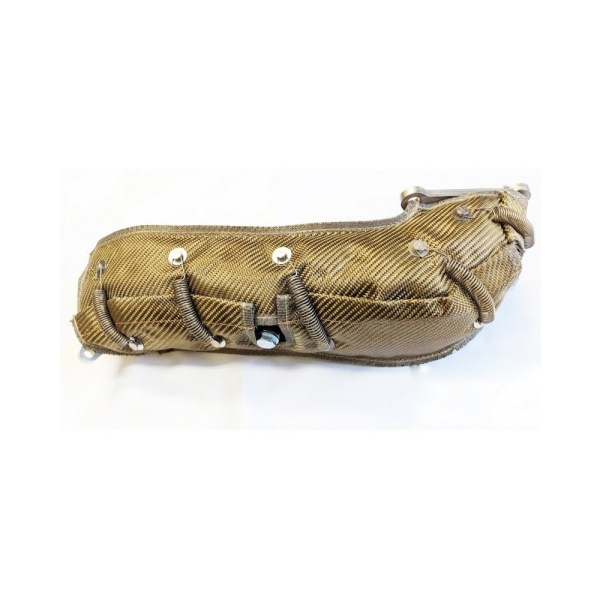
An exhaust insulation blanket is a removable, multi-layer thermal cover designed to encapsulate exhaust components such as:
Turbochargers
Exhaust manifolds
Exhaust pipes and silencers
It typically consists of:
A high-temperature insulation core (ceramic, silica, or fiberglass)
A reinforced outer layer (stainless steel mesh or coated fabric)
The key feature is controlled, uniform insulation combined with easy removal for inspection and maintenance.
Exhaust wrap is a flexible tape-like material wound directly around exhaust pipes. It is commonly made from fiberglass or basalt fibers and is applied by tightly wrapping the material along the pipe surface.
Exhaust wrap is:
Inexpensive
Permanent once installed
Widely available
However, its simplicity also introduces several limitations in professional applications.
Provides consistent insulation thickness
Reduces radiant heat by up to 90%
Maintains performance over long operating periods
Insulation thickness depends on installation quality
Heat reduction is moderate and uneven
Performance degrades as fibers age
In controlled environments, blankets generally deliver more predictable and stable thermal performance.
Designed for repeated heat cycles
Resistant to vibration and movement
Service life typically 2–5 years
Fibers break down over time
Absorbs moisture and oil
Often requires replacement within 6–18 months
In industrial and turbo applications, durability often becomes the deciding factor.
Installed using hooks, springs, or lacing wire
Easily removed for inspection
Ideal for systems requiring regular maintenance
Time-consuming installation
Difficult to remove without damage
Makes visual inspection of pipes difficult
For equipment requiring compliance inspections or routine servicing, removability is a major advantage.
One often overlooked factor is long-term impact on the exhaust itself.
Exhaust wraps can trap moisture against metal surfaces, increasing the risk of corrosion
Insulation blankets allow better airflow and drainage around components
In environments with humidity, condensation, or outdoor exposure, this difference becomes critical.
Wrap: entry-level or temporary builds
Blanket: turbochargers, performance engines
Wrap: rarely recommended
Blanket: preferred for safety and compliance
Wrap: not suitable
Blanket: standard solution
Wrap: corrosion risk
Blanket: moisture-resistant designs available
At first glance, exhaust wrap appears cheaper. However, long-term cost often tells a different story.
| Factor | Insulation Blanket | Exhaust Wrap |
|---|---|---|
| Initial Cost | Higher | Lower |
| Service Life | Long | Short |
| Maintenance | Easy | Difficult |
| Replacement Frequency | Low | High |
For systems operating continuously or under high heat, insulation blankets usually provide lower total cost of ownership.
Many industrial and commercial environments require:
Reduced surface temperatures
Fire-resistant materials
Protection for personnel
Exhaust insulation blankets are easier to engineer for specific safety standards, while exhaust wraps offer limited compliance options.
Exhaust wrap may still be appropriate when:
Budget is extremely limited
Operating temperatures are moderate
The application is temporary or experimental
It is often chosen for non-critical systems where longevity is not a priority.
An exhaust insulation blanket is typically the better choice when:
Temperatures are consistently high
Equipment requires regular inspection
Safety and reliability are critical
Long-term operating cost matters
In professional and industrial environments, insulation blankets are usually selected by default.

No.10, Chuangxin North Road, Nanshan Park, Ningguo Economic and Technological Development Zone, Ningguo City, Anhui Province, China
Tel/Whatsapp : 0086-15856303740
Email : sales@bstbraidedsleeve.com
Skype : vanesa-cheng