What are you looking for?
Choosing between stainless steel heat shield material and aluminum heat shield material is not simply a question of which metal can tolerate more heat. The correct choice depends on where the shield will be installed, the intensity of the heat source, vehicle weight targets, corrosion exposure, vibration, forming requirements and the expected service life of the component.
Both materials are widely used in automotive thermal management systems, but they perform differently. Aluminum is attractive where low weight and efficient radiant heat reflection are priorities. Stainless steel is generally selected when the heat shield is located closer to demanding exhaust components and requires greater mechanical durability.
BSTFLEX manufactures both stainless steel heat shield material and embossed aluminum heat shield material for automotive exhaust systems, engine compartments, underbody heat barriers and custom OEM thermal protection projects.
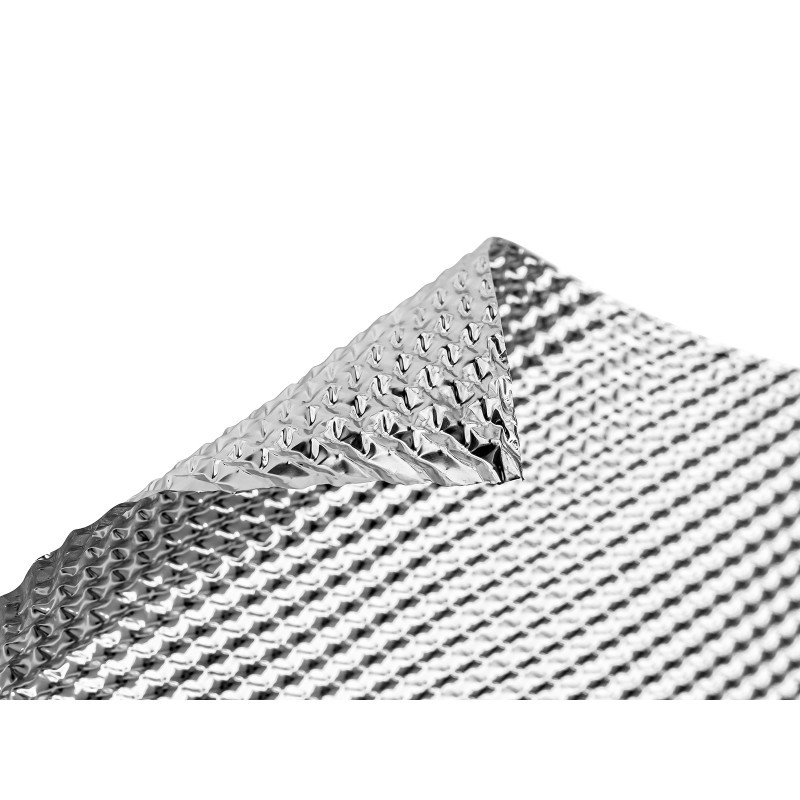
Stainless steel heat shield material is a thin metallic thermal barrier designed for applications where heat exposure, vibration, corrosion and mechanical loading must be managed at the same time. In automotive systems, it is frequently formed into shields around exhaust manifolds, catalytic converters, exhaust pipes, mufflers and other hot-zone components.
The material can be supplied with an embossed surface rather than as a completely flat metal sheet. Embossing increases rigidity and helps a thin sheet retain its shape after forming. This is particularly useful for automotive heat shields that need to remain lightweight while resisting vibration and deformation during vehicle operation.
BSTFLEX stainless steel thermal barrier sheet is available in multiple thickness options and can be produced with different embossing patterns according to component geometry and customer manufacturing requirements.
Aluminum heat shield material is a lightweight metallic barrier commonly used to reduce radiant heat exposure in vehicles. Its low density makes it particularly valuable when engineers need thermal protection without adding unnecessary mass to the vehicle.
Aluminum also has a naturally useful surface for reflecting radiant thermal energy. For this reason, aluminum heat shielding material is frequently found in engine compartments, underbody systems, intake areas, transmission tunnels and other locations where radiant heat control is more important than direct exposure to the most severe exhaust temperatures.
An embossed construction can improve stiffness while allowing relatively thin material to be used. BSTFLEX supplies embossed aluminum thermal barrier sheet for automotive and industrial applications requiring lightweight, formable heat shielding.
| Comparison | Stainless Steel Heat Shield Material | Aluminum Heat Shield Material |
|---|---|---|
| Weight | Heavier than aluminum | Significantly lighter |
| High Temperature Capability | Better suited to severe heat zones | Better suited to moderate thermal environments |
| Mechanical Strength | Higher strength and impact resistance | Lower strength but easier to form |
| Corrosion Resistance | Excellent in demanding environments | Good for many automotive environments |
| Radiant Heat Reflection | Effective when correctly designed | Excellent for lightweight radiant heat barriers |
| Formability | Suitable for stamped and formed shields | Highly suitable for lightweight formed shields |
| Typical Location | Exhaust manifold, catalytic converter, muffler, exhaust pipe | Engine bay, underbody, intake area, transmission tunnel |
| Best Selection Driver | Durability and higher thermal demand | Weight reduction and radiant heat control |
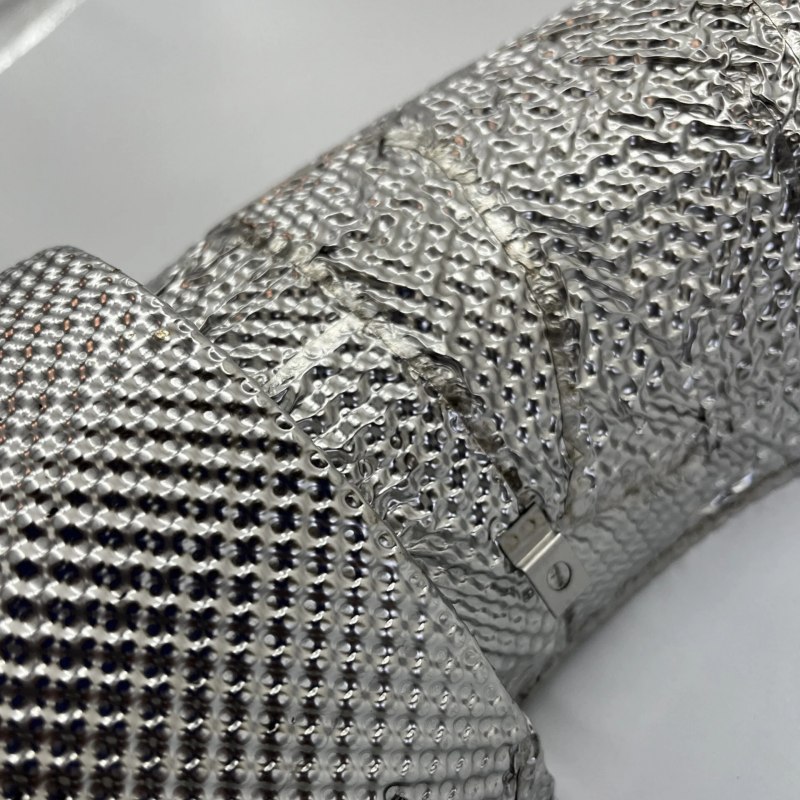
For applications positioned very close to an exhaust manifold, catalytic converter, turbocharger outlet or other intense heat source, stainless steel is normally the stronger candidate. It maintains useful mechanical properties in demanding thermal environments and is less vulnerable to loss of structural integrity caused by repeated heating cycles.
This makes stainless steel exhaust heat shield material particularly suitable where the shield must survive a combination of heat, vibration, road contamination and long-term vehicle operation.
Aluminum can still be highly effective in exhaust-related thermal management, but its application should be selected carefully. It performs especially well when used as a radiant barrier with appropriate spacing from the heat source rather than as a metal shield placed in the most severe hot zone.
Aluminum has a clear advantage when mass reduction is a design priority. Automotive engineers continually look for opportunities to reduce component weight without sacrificing necessary thermal protection, especially in performance vehicles, electric vehicles and fuel-efficiency-focused platforms.
An embossed aluminum heat shield can cover a relatively large area while remaining lightweight. Typical applications include floor pan protection, underbody heat barriers, engine bay shields and areas adjacent to exhaust components where sufficient air gap is available.
For projects in which every gram matters, aluminum heat shield material is often the first material engineers evaluate.
Stainless steel generally provides the advantage when durability includes resistance to impact, vibration, corrosion and repeated thermal cycling.
An automotive heat shield does not operate in a laboratory environment. Depending on its position, it may be exposed to water, road salt, dirt, engine fluids, stone impact and continuous vibration. Exhaust-mounted shields can also experience frequent expansion and contraction as the vehicle moves between ambient and operating temperatures.
For these conditions, embossed stainless steel heat shield material provides a useful balance between thin-wall construction, mechanical strength and service durability.
The surface geometry of a metal heat shield is almost as important as the base material. A completely flat thin sheet can be relatively flexible and may be susceptible to vibration or distortion. Embossing introduces three-dimensional geometry into the sheet and increases structural stiffness without requiring a major increase in material thickness.
For OEM heat shield design, an embossed surface may provide several practical advantages:
BSTFLEX can manufacture different embossing patterns according to part dimensions, tooling requirements and the intended application.
One of the strongest applications for stainless steel is exhaust thermal protection. Modern exhaust systems contain several components capable of creating concentrated heat close to the vehicle body, wiring, fuel lines and other temperature-sensitive systems.
Typical applications include:
In these locations, stainless steel provides engineers with a rigid metal heat shield material that combines temperature capability with mechanical resistance.
Aluminum is especially useful where radiant heat must be controlled across a relatively large surface without adding excessive weight.
Common applications include:
Because aluminum is easy to form, engineers can develop complex lightweight shield geometries for limited-space vehicle installations.
Turbocharger environments can create significantly more demanding thermal conditions than many conventional engine bay locations. Stainless steel may be appropriate for numerous turbo-related shields, but extreme-duty systems can require a higher-performance alloy.
For racing, high-output engines and applications involving prolonged extreme temperature exposure, BSTFLEX also manufactures Inconel 625 heat shield material. This provides an additional material option when stainless steel or aluminum does not meet the thermal or durability requirements of the project.
The correct material should be selected from the actual operating conditions rather than from a single temperature number. OEM engineers should evaluate the complete thermal and mechanical environment surrounding the part.
Key selection factors include:
If the application prioritizes low mass and radiant heat reflection, aluminum is often the more efficient solution. If the shield must withstand harsher exhaust-side conditions and greater mechanical loading, stainless steel is normally the better starting point.
For a heat shield installed close to an exhaust manifold, stainless steel is generally preferred because the location combines high temperature exposure with vibration and repeated thermal cycling.
For a secondary barrier positioned farther from the manifold, aluminum may still provide effective radiant heat protection while reducing component weight. The final design should consider heat source temperature, distance, airflow and mounting configuration.
Aluminum is frequently an excellent choice for intake heat shield applications because the objective is usually to reduce radiant heat reaching an air intake system rather than to contain direct exhaust heat.
Its low weight, reflectivity and formability make aluminum heat shield material particularly suitable for air boxes, intake barriers and engine compartment partitions.
Yes. A vehicle thermal management system does not need to use the same material in every location. It is common for engineers to select different heat shielding materials according to the temperature and mechanical requirements of each zone.
For example, stainless steel can be used close to an exhaust component while aluminum is used on a larger secondary barrier farther from the heat source. Multi-layer assemblies may also combine metallic skins, air gaps or insulation layers when greater thermal reduction is required.
Material selection is only one part of developing an effective automotive heat shield. Thickness, embossing geometry, mounting points, air gap, forming depth and shield shape can all influence final performance.
BSTFLEX supplies heat shield materials for prototype development, replacement programs and OEM production. Available manufacturing support includes customized sheet dimensions, material thicknesses, embossing patterns and application-specific development.
Customers can compare the following materials for their projects:
Neither material is universally better. Stainless steel is generally preferred for hotter, mechanically demanding exhaust applications, while aluminum is preferred when low weight and radiant heat reflection are the main design requirements.
Stainless steel is widely suitable for automotive exhaust heat shields because it combines thermal resistance, mechanical strength and corrosion resistance. Aluminum can be used in lower thermal load areas, while Inconel alloys may be selected for exceptionally demanding environments.
Embossing improves the stiffness of thin aluminum sheet and helps large heat shield surfaces resist deformation and vibration without relying solely on increased material thickness.
Embossing gives thin stainless steel sheet additional rigidity and structural stability, which is particularly useful for automotive exhaust heat shields exposed to vibration and repeated thermal cycling.
Aluminum is commonly selected for engine bay heat shielding because it is lightweight and effective at reducing radiant heat exposure. Stainless steel may be more appropriate close to exhaust-side components where temperatures and mechanical loads are higher.
Stainless steel is a common choice for catalytic converter heat shielding because the area can experience substantial heat, vibration and environmental exposure. The final material and construction should be determined from the actual operating conditions of the vehicle.
Yes. BSTFLEX can supply metal heat shield materials with customized thickness, dimensions, embossing patterns and forming specifications for automotive OEM, exhaust system and industrial thermal management projects.
For most automotive projects, the decision can be summarized simply: choose aluminum when lightweight radiant heat protection is the priority, and choose stainless steel when the component requires greater durability in a hotter and more mechanically demanding environment.
Where the operating conditions exceed the practical range of conventional automotive metals, higher-performance alloys such as Inconel 625 can be evaluated.
For OEM projects, prototypes or production requirements, BSTFLEX can assist with material selection based on the heat source, installation location, component geometry and manufacturing requirements. Send your drawing, dimensions, material specification or application details to request a suitable metal heat shield material recommendation and quotation.

No.10, Chuangxin North Road, Nanshan Park, Ningguo Economic and Technological Development Zone, Ningguo City, Anhui Province, China
Tel/Whatsapp : 0086-15856303740
Email : sales@bstbraidedsleeve.com
Skype : vanesa-cheng