What are you looking for?
Controlling exhaust heat is not simply a matter of choosing the material with the highest temperature rating.
The geometry of the exhaust component, required service access, vibration level, operating environment and expected maintenance interval all influence which insulation method will work best.
Two of the most common solutions are the exhaust blanket and exhaust wrap.
Both can reduce heat radiated from exhaust components, but they are designed for different installation conditions.
An exhaust blanket is normally a shaped, removable insulation assembly manufactured around a specific component. Exhaust wrap is supplied as a narrow roll of heat-resistant textile that is spirally wound around exhaust tubing.
For straight pipes, headers and relatively simple tubular sections, exhaust wrap can be a practical solution. For turbochargers, manifolds, elbows, silencers, generators and equipment requiring regular servicing, a removable exhaust insulation blanket usually provides greater flexibility.
BSTFLEX manufactures both exhaust heat shield insulation and exhaust and header heat wrap, allowing the insulation method to be selected according to the actual exhaust system rather than forcing one product type into every application.
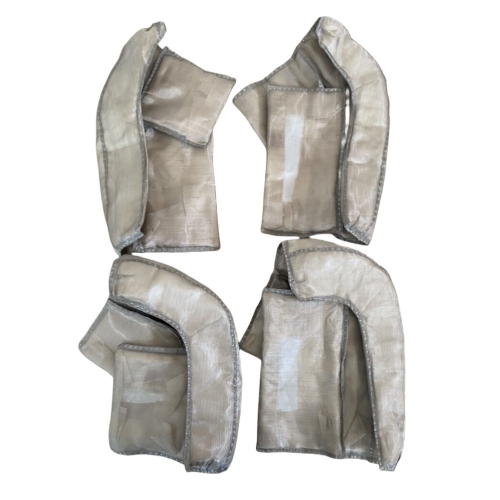
For applications requiring removable insulation, controlled insulation thickness or coverage of complex exhaust components, an exhaust blanket is usually the better option.
For long exhaust tubes, individual header runners, motorcycle pipes or applications where a lower-cost continuous wrapping method is preferred, exhaust wrap may be more practical.
The distinction can be summarized as follows:
| Requirement | Exhaust Blanket | Exhaust Wrap |
|---|---|---|
| Removable for servicing | Excellent | Poor |
| Complex component geometry | Excellent | Moderate |
| Long straight pipe | Good | Excellent |
| Consistent insulation thickness | Excellent | Installation dependent |
| Fast field installation | Good | Moderate |
| Header runners | Limited depending on design | Excellent |
| Turbocharger housing | Excellent | Not normally preferred |
| Large exhaust silencer | Excellent | Difficult |
| Generator exhaust | Excellent | Good for selected pipe sections |
| Marine dry exhaust | Excellent | Application dependent |
| Custom OEM fit | Excellent | Limited |
| Initial material cost | Higher | Lower |
| Repeated maintenance | Excellent | Poor |
The better product therefore depends on where the insulation will be installed.
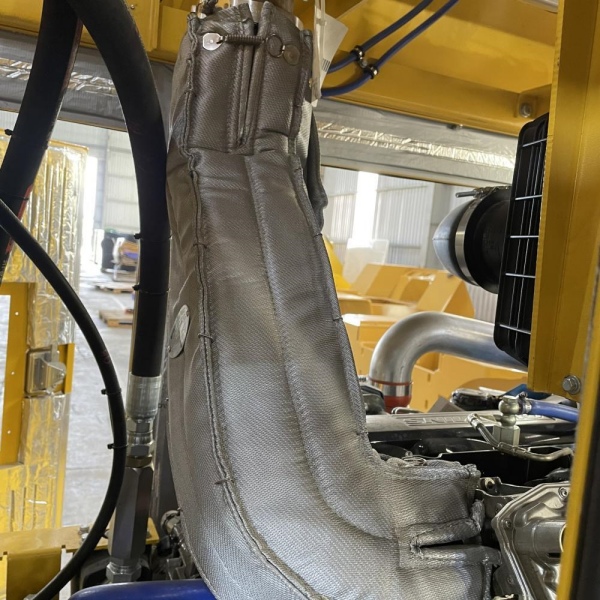
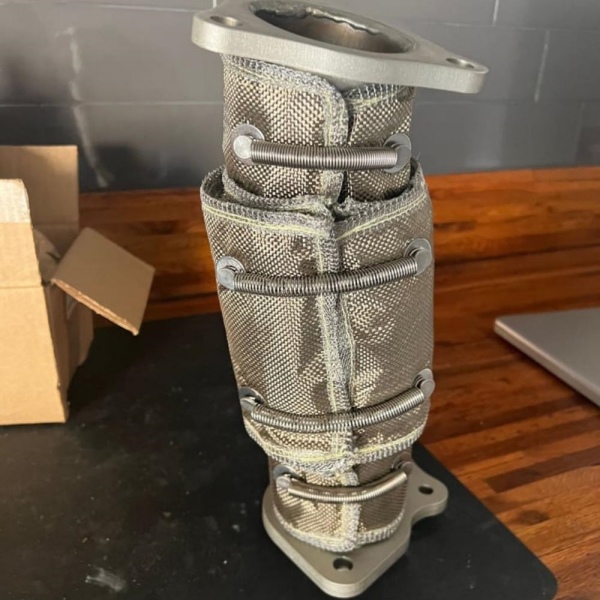
An exhaust blanket, also called an exhaust insulation blanket, is a flexible thermal insulation component manufactured to fit around an exhaust part.
Unlike a roll of insulation material, the blanket is normally fabricated into a predetermined shape.
A typical construction may include:
a hot-side inner layer;
a high-temperature insulation core;
a durable outer fabric or metal-facing layer;
reinforced seams;
hooks, springs, wire lacing or other fastening hardware.
The insulation thickness can be controlled throughout the blanket, allowing the manufacturer to design the thermal barrier according to the application.
BSTFLEX develops custom exhaust blankets for components including:
turbochargers;
exhaust manifolds;
downpipes;
exhaust pipes;
exhaust elbows;
silencers;
mufflers;
diesel engines;
generator sets;
marine exhaust systems.
For a complete overview of this construction, see the BSTFLEX Exhaust Insulation Blanket guide.
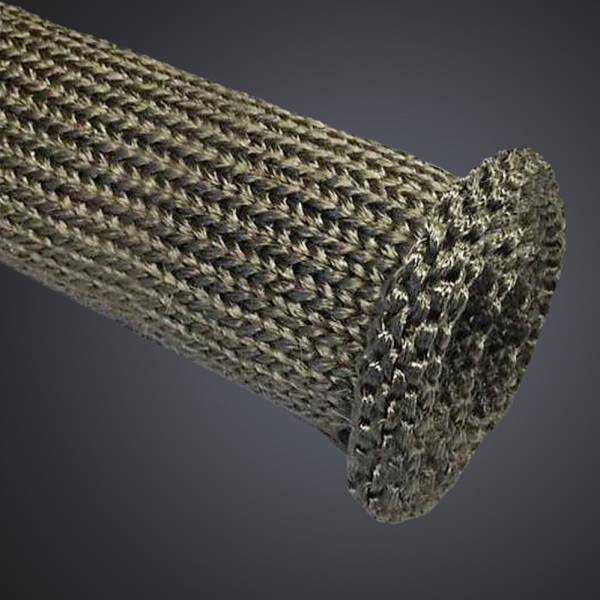
Exhaust wrap is a narrow woven thermal insulation tape designed to be wrapped around exhaust tubing in overlapping layers.
Typical materials include:
fiberglass;
basalt;
titanium-style basalt fiber;
silica or other high-temperature textile constructions.
Installation generally begins at one end of the exhaust tube. The wrap is wound around the pipe with a controlled overlap and secured using stainless steel ties or clamps.
BSTFLEX supplies a complete Exhaust and Header Heat Wrap range for automotive, motorcycle, marine and industrial exhaust applications. Google currently recognizes this category as covering fiberglass, basalt, ceramic-enhanced and other high-temperature wrap constructions.
The biggest difference between an exhaust blanket and exhaust wrap is not simply the fiber used.
It is the way the insulation is engineered around the component.
A blanket is fabricated before installation.
The manufacturer can control:
overall shape;
thickness;
seam location;
openings;
cut-outs;
fastening position;
insulation density;
hot-side material;
outer protective material.
Wrap becomes the insulation system during installation.
Final performance therefore depends more heavily on:
overlap percentage;
wrapping tension;
number of layers;
installer technique;
pipe geometry;
fastening quality.
Two pipes wrapped with the same material may therefore have different effective insulation thicknesses if installation methods differ.
Both systems can reduce heat escaping from an exhaust component, but the way they achieve this differs.
A properly designed blanket provides a relatively uniform insulation layer around the component.
Because the insulation core can be manufactured to a specified thickness, thermal performance can be engineered more predictably.
This is useful where an OEM or equipment manufacturer needs repeatable insulation across multiple units.
Wrap also keeps heat close to the pipe, but its final thickness depends on the installation.
A tighter overlap creates additional layers, while insufficient overlap may create areas with lower thermal resistance.
For a custom-built vehicle this may be acceptable. For production equipment requiring consistent assembly between units, a fabricated blanket may offer better repeatability.
For a long, relatively straight exhaust pipe, exhaust wrap often has an installation advantage.
It can follow:
straight tubing;
gradual bends;
header runners;
motorcycle exhaust tubes;
downpipes.
There is no need to manufacture a separate shaped insulation component for every pipe section.
However, exhaust blankets become increasingly attractive when the pipe includes:
flanges;
sensors;
expansion joints;
service connections;
large-diameter tubing;
complex elbows;
regularly inspected sections.
A removable exhaust heat shield insulation system can be manufactured as individual segments so that one section can be removed without disturbing the remainder of the exhaust line.
The answer depends strongly on manifold geometry.
Individual header tubes are often well suited to exhaust wrap because the tape can follow each runner.
A shaped blanket can be more practical because it covers the manifold as one thermal zone.
This is particularly useful for:
turbo manifolds;
compact diesel manifolds;
heavy-duty engines;
industrial engines.
BSTFLEX already manufactures shaped manifold thermal protection including the Titanium Header Manifold Blanket and related manifold insulation designs.
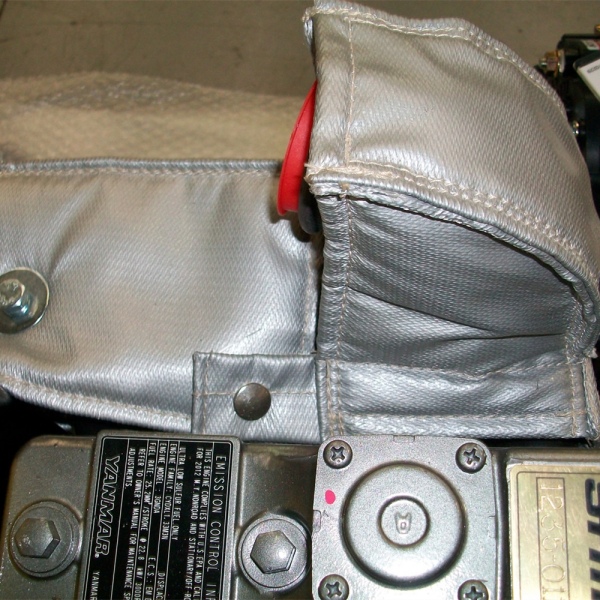
For a turbocharger turbine housing, a fitted blanket is generally much more practical than exhaust wrap.
Turbochargers contain:
curved housings;
flanges;
wastegate areas;
oil lines;
coolant connections;
actuator components.
These features make spiral wrapping difficult.
A turbo blanket can instead be shaped around the turbine housing while leaving the required connections accessible.
For the exhaust tubing before or after the turbocharger, wrap may still be useful.
This illustrates an important principle:
The correct thermal management system may use both blankets and wrap on the same exhaust assembly.
Maintenance is one of the clearest differences.
A removable blanket can normally be:
unfastened;
removed;
inspected;
reinstalled.
This makes it suitable for equipment that requires regular servicing.
Typical examples include:
generator sets;
marine engines;
industrial engines;
mining equipment;
heavy machinery.
Wrap is generally treated as a semi-permanent installation.
Once removed, it may be difficult to reinstall with the same tension and overlap.
This becomes important when technicians need frequent access to:
welds;
flanges;
sensors;
pipe joints;
exhaust connections.
For maintenance-intensive machinery, a segmented blanket system can significantly simplify access.
Exhaust systems experience continuous vibration.
The suitability of either insulation method therefore depends on installation quality.
A custom blanket can include:
reinforced edges;
stainless steel mesh;
abrasion-resistant outer fabrics;
heavy-duty stitching;
spring retention;
stainless steel hardware.
This construction can be optimized around known contact areas.
Exhaust wrap relies largely on the textile itself and the retention ties. If the wrapped pipe contacts another component, local abrasion can gradually damage the fibers.
For installations where rubbing or severe vibration is expected, mechanical protection should be evaluated during design.
Environmental conditions can be as important as temperature.
Applications may involve:
rain;
road spray;
salt;
engine oil;
fuel contamination;
marine humidity;
cleaning fluids.
Both blankets and wraps should therefore be selected according to the real environment.
A removable blanket provides one practical advantage: it can be removed so that the underlying exhaust component can be inspected.
With a permanently wrapped pipe, inspecting the covered metal requires removing the wrap.
This is particularly relevant for marine and industrial maintenance programs.
Marine exhaust systems often require access for inspection and maintenance.
Dry marine exhaust components may include:
manifolds;
turbochargers;
exhaust risers;
elbows;
silencers;
generator exhaust pipes.
For large or irregularly shaped components, removable blankets are generally easier to engineer and service.
Wrap may still be useful on selected tubular sections where continuous insulation is required and inspection access is less important.
The blanket outer layer and fastening system should be selected with the marine environment in mind.
Generators are another application where removable insulation has a strong advantage.
Generator exhaust systems may contain:
turbochargers;
manifolds;
flexible connectors;
elbows;
pipes;
silencers.
Maintenance personnel may need access to these components throughout the service life of the equipment.
A sectional blanket system allows individual parts to be exposed without removing insulation from the complete exhaust line.
Wrap may still be used on certain straight pipes, but it is less convenient around repeatedly serviced connections.
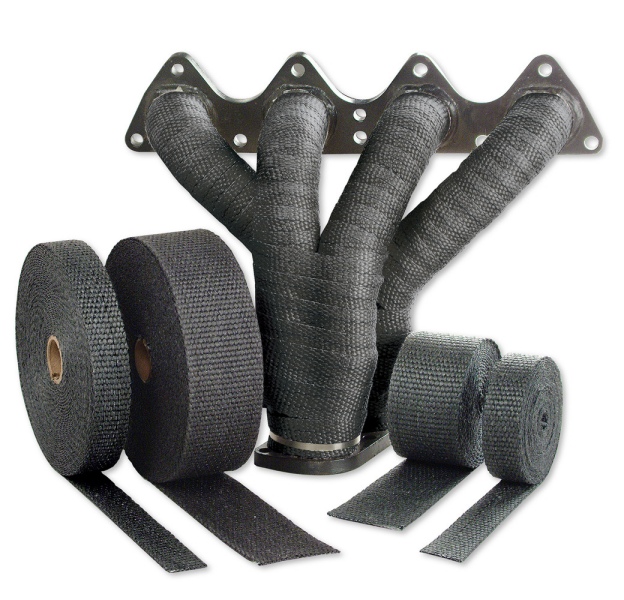
Automotive applications are more mixed.
Exhaust wrap works particularly well for:
tubular headers;
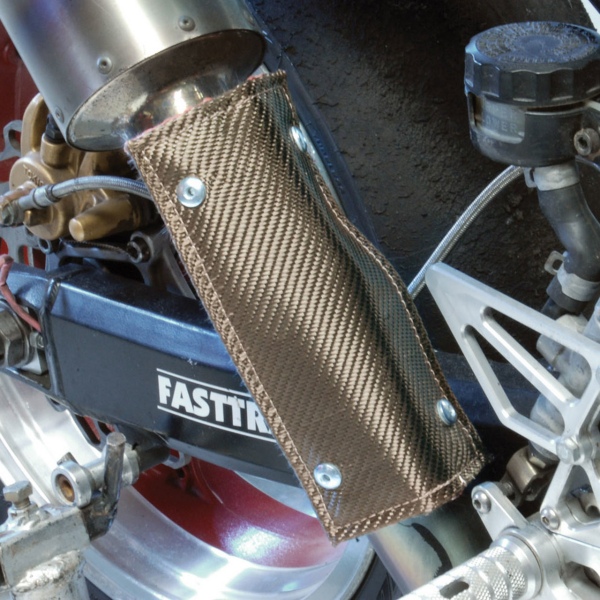
motorcycle exhaust systems;
custom exhaust tubing;
motorsport installations;
aftermarket performance systems.
An exhaust blanket is often preferred for:
turbochargers;
manifolds;
downpipes;
catalytic converter housings;
mufflers;
irregular exhaust components.
Modern vehicles may also use formed metal heat shields around catalytic converters and underbody exhaust sections.
Therefore, blanket versus wrap should not be treated as an either-or decision for an entire vehicle.
Different parts of the exhaust system may require different thermal protection methods.
Typical installation requires:
measuring the required wrap length;
preparing the pipe;
wrapping with consistent tension;
maintaining the required overlap;
working carefully around bends;
installing stainless steel ties or clamps.
Installation quality directly affects the finished result.
A custom blanket is generally placed around the target component and secured with its integrated fastening system.
This can reduce installation time for complex components.
However, correct blanket dimensions are important. A poorly fitted blanket may interfere with adjacent parts or leave unwanted gaps.
This is why custom blanket manufacturing normally begins with accurate dimensional information.
Exhaust wrap usually has the lower initial material cost.
This makes it attractive for:
single vehicles;
motorcycles;
prototypes;
low-budget performance projects;
simple tubular systems.
A custom blanket has a higher manufacturing cost because it requires:
pattern development;
cutting;
insulation assembly;
sewing;
reinforcement;
fastening hardware.
However, initial price is only one component of total cost.
For commercial equipment, other factors include:
installation labor;
removal time;
replacement frequency;
maintenance access;
equipment downtime.
For equipment that requires repeated servicing, the ability to remove and reinstall a blanket can offset some of the higher initial cost.
This is another area where blankets differ substantially from wrap.
Exhaust wrap is primarily customized by choosing:
width;
thickness;
material;
color;
roll length.
A custom exhaust blanket can additionally be engineered around:
exact component geometry;
flanges;
brackets;
sensor ports;
inspection openings;
pipe penetrations;
fastener locations;
insulation thickness;
outer material;
hot-side material.
BSTFLEX can develop custom exhaust insulation blankets from drawings, CAD geometry, dimensions or physical samples.
For OEM production, the decision should be based on assembly repeatability and lifecycle requirements.
the component is primarily tubular;
manufacturing cost must be minimized;
servicing access is infrequent;
installation can be standardized;
complex pattern development is unnecessary.
the component has irregular geometry;
insulation thickness must be controlled;
repeated removal is expected;
technicians need easy access;
different thermal zones require different insulation thicknesses;
the insulation must look consistent across production units.
An OEM may also specify both systems.
For example:
Header runners: exhaust wrap
Turbocharger: removable blanket
Downpipe: fitted blanket
Long exhaust tube: wrap or pipe jacket
Catalytic converter: metal heat shield
This system-level approach is often more effective than selecting one insulation technology for every component.
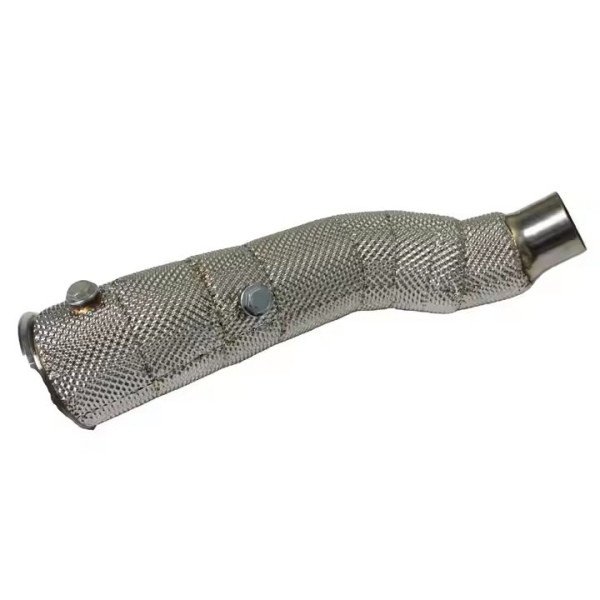
| Application | Usually Better Choice | Why |
|---|---|---|
| Turbocharger housing | Exhaust blanket | Complex geometry and removability |
| Cast exhaust manifold | Exhaust blanket | Shaped insulation coverage |
| Tubular header runners | Exhaust wrap | Easily follows individual tubes |
| Long straight exhaust pipe | Exhaust wrap or blanket | Depends on service requirement |
| Generator exhaust | Exhaust blanket | Maintenance access |
| Marine dry exhaust | Exhaust blanket | Removable sectional insulation |
| Motorcycle exhaust | Exhaust wrap | Compact tubular geometry |
| Large silencer | Exhaust blanket | Better coverage of large surface |
| Exhaust elbow | Shaped blanket | Complex geometry |
| Motorsport header | Exhaust wrap | Lightweight continuous coverage |
| Industrial engine | Exhaust blanket | Repeatable engineered insulation |
| Prototype exhaust pipe | Exhaust wrap | Fast and economical |
Yes.
In many applications this is the most practical solution.
Consider a turbocharged engine:
header runners may use wrap;
the turbocharger may use a fitted blanket;
the downpipe may use either a blanket or wrap;
the catalytic converter may use a metal heat shield.
Each component experiences different:
temperature;
geometry;
airflow;
vibration;
clearance;
service requirements.
Thermal management should therefore be engineered by component rather than by selecting one universal insulation material.
Neither is universally better. Exhaust blankets are generally better for complex components, removable insulation and equipment requiring maintenance. Exhaust wrap is often better for continuous pipe, tubular headers and installations where simple low-cost thermal containment is required.
Yes. Exhaust wrap is specifically designed for tubular exhaust components and can be effective on headers, downpipes and exhaust pipes when correctly installed.
A properly manufactured removable blanket can generally be removed for inspection and reinstalled, provided the blanket and fastening system remain in serviceable condition.
A fitted turbo blanket is normally more suitable because it can follow the turbine-housing geometry while leaving oil lines, coolant lines and other connections accessible.
Removable exhaust blankets are often preferred because generator exhaust components require periodic inspection and servicing.
Exhaust wrap normally has a lower initial material cost. Custom blankets cost more to manufacture but can provide benefits in repeatable installation and maintenance access.
Yes. Different sections of one exhaust system can use different insulation technologies according to geometry, temperature and maintenance requirements.
Useful information includes component drawings or dimensions, operating temperature, photographs, insulation clearance, application environment and required quantity.
For simple tubular exhaust systems, exhaust wrap remains a practical and economical heat-control method.
For complex components, high-duty equipment and installations requiring regular maintenance, a custom exhaust blanket generally provides greater control over insulation thickness, fit and serviceability.
The correct choice therefore depends less on which product is theoretically “better” and more on how the exhaust component is designed and operated.
BSTFLEX manufactures both exhaust insulation and heat shield solutions and exhaust header heat wraps for automotive, marine, diesel, generator and industrial applications.
For a custom blanket project, provide component drawings, dimensions, operating temperature, installation photographs and estimated quantity. BSTFLEX can evaluate whether a removable exhaust blanket, exhaust wrap, metal heat shield or combination of these technologies is the more appropriate solution.

No.10, Chuangxin North Road, Nanshan Park, Ningguo Economic and Technological Development Zone, Ningguo City, Anhui Province, China
Tel/Whatsapp : 0086-15856303740
Email : sales@bstbraidedsleeve.com
Skype : vanesa-cheng