What are you looking for?

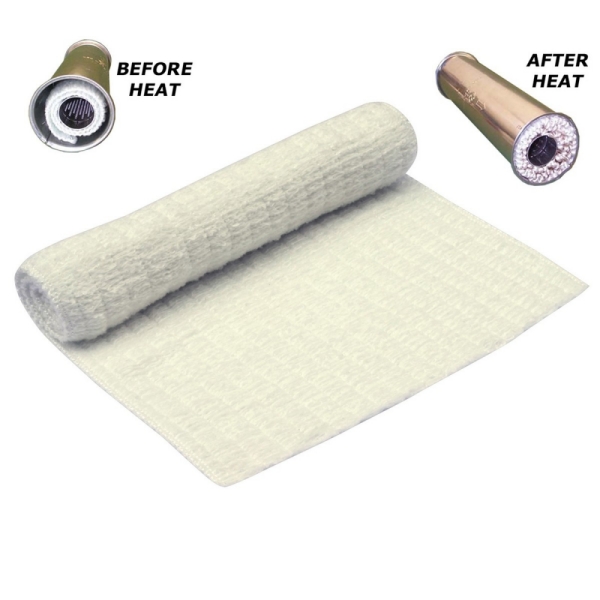
Expanding exhaust packing is installed in a compact form and designed to release its compressed fiber structure when heated. In a heat-released fiberglass sheet, temporary stitching holds texturized glass yarn together during handling and assembly. When the stitching loses its restraining function, the fiber structure can open into the space allocated to it inside the silencer.
The important distinction is that the packing becomes bulkier without creating more glass fiber. Its performance still depends on the material grade, filling quantity, chamber geometry and final distribution. An expanding sheet is not a substitute for specifying how much acoustic material the silencer needs.
The BSTFLEX Exhaust Baffle Silencer Packing Sheet uses compressed, texturized continuous-filament glass yarn with low-melting-point stitching. For exhaust manufacturers evaluating this construction, the starting point is the relationship between its compact installation state and its released state in service.
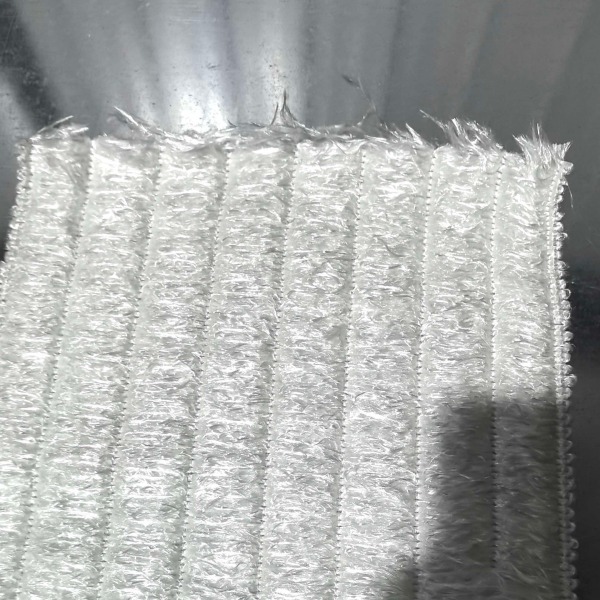
In this construction, texturization creates a bulky arrangement of glass filaments. The material is compressed into a manageable sheet, and temporary stitching restrains that structure. Heat releases the restraint so the yarn can recover bulk within the available space.
This is not glass melting into a larger shape, nor is it an intumescent foam reaction. The substantial change in bulk comes from the arrangement of the fibers. The term self expanding muffler packing describes this release behavior; it does not mean the material grows indefinitely or automatically produces the correct installed density.
| Material State | Role of the Construction | What to Check |
|---|---|---|
| Before installation | Temporary stitching keeps the compressed fiber structure in sheet form. | Material identification, cut dimensions, weight and condition of the stitching. |
| During initial heating | The heat-responsive restraint releases, allowing the fiber structure to open. | The specified heating conditions and whether the installed arrangement permits release. |
| After release | The released fiber can occupy the accessible space assigned to the acoustic filling. | Coverage, distribution, retention and performance in the complete silencer. |
A released sheet should not be expected to return automatically to its original stitched condition after cooling. Treat the compact form as an assembly aid, not as a reversible mechanism that resets during every engine cycle.
For an assembly line, the attraction is practical: a defined piece of material can be positioned before the fiber reaches its released bulk. The buyer can specify a cut area and weight instead of leaving the quantity entirely to the operator's judgment.
When evaluating an expanding muffler packing sheet, compare the work needed to prepare, position and close the assembly. Record whether the sheet fits through the insertion opening, whether it catches on internal features and whether it stays in the intended position before the shell is closed.
This does not make sheet packing universally better than loose fiber or a direct-filling process. It provides a different route to a controlled fiber charge. Other muffler packing materials and supply formats remain relevant where they suit the existing equipment and approved silencer design.
The gap around a perforated tube is not always uniform. An offset tube, oval shell or shaped end section creates regions with different radial clearances. For these designs, assess the compact packing layout and the space into which it is expected to release.
Expanding silencer packing can be evaluated where a compact starting form is useful for filling an irregular cavity. However, release cannot be assumed to move fibers through a partition or around every obstruction. Divide a multi-chamber silencer into its actual filling zones and specify the quantity and placement for each zone.
Check the narrow side of an offset core as well as the wider cavity. A satisfactory total filling weight does not prove that both areas contain the required material. Inspect a trial assembly after the agreed heating cycle to verify the distribution rather than relying on the outside appearance of the closed shell.
There are two separate decisions: how much fiber the design requires, and how that fiber is introduced into the chamber. Heat release addresses the second decision. It does not establish the first.
Average installed fiber density = dry glass-fiber mass / net volume assigned to that fiber.
If a fixed fiber charge occupies more volume after release, its average bulk density decreases. That arithmetic does not tell you whether the resulting density is acoustically suitable. Likewise, a chamber that looks full can still contain too little fiber for its approved specification.
Use an existing validated filling mass or establish a target through development testing. Do not reduce the fiber charge solely because the replacement material is described as self expanding.
When the sheet's glass-fiber mass per unit area is known, the required cut length can be calculated:
Cut length in meters = required glass-fiber mass in grams / (sheet width in meters × glass-fiber areal weight in g/m2).
For illustration only, assume a project has already approved a 240 g fiber charge, a 0.40 m sheet width and a glass-fiber areal weight of 600 g/m2. The calculated cut length is 240 / (0.40 × 600) = 1.00 m. These are hypothetical values explaining the calculation, not a BSTFLEX product specification or a recommended filling density.
Confirm whether the quoted areal weight covers the glass fiber alone or the complete sheet, including temporary stitching and any other constituents. Use the same mass basis in the drawing, calculation and inspection record. Recheck the result when cutting, trimming or overlapping changes the quantity installed.
In a common core-wrapping arrangement, the sheet width follows the effective packed length of the silencer, while the cut length is taken around the core. The approved layout must identify that orientation; a dimension labeled simply "length" can otherwise mean different things to the supplier and assembler.
For exhaust silencer infill ordered by the meter, state the width and areal weight as well. One meter of two different sheets does not necessarily contain the same fiber mass. Nor does one circumference around the core determine the quantity needed for the surrounding chamber.
Specify end clearances, layer arrangement and any separately filled spaces on the drawing. For an irregular assembly, a marked cutting layout is more useful than a general instruction to wrap until full.
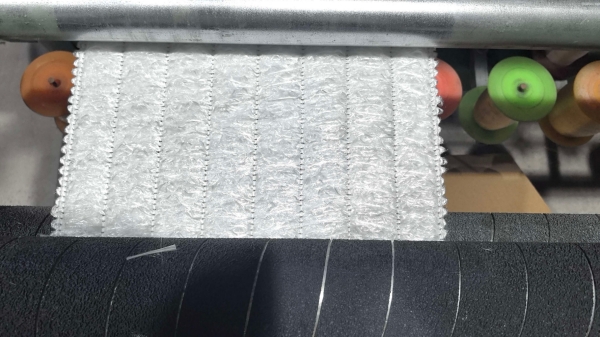
When sourcing heat expanding exhaust packing, separate the behavior of the stitching from the capability of the glass fiber. The low-melting-point thread releases the compressed structure; the glass fiber must remain suitable for the intended service conditions.
| Temperature Information | What It Describes | What to Request |
|---|---|---|
| Release conditions | The conditions under which the temporary restraint loses its holding function. | The material-specific temperature range, exposure time and approved conditioning method. |
| Continuous service conditions | The sustained environment experienced by the acoustic fiber and surrounding components. | The proposed fiber grade and evidence relevant to the intended duty. |
| Peak exposure | Shorter temperature excursions beyond normal running conditions. | Peak value, duration, frequency and measurement location. |
A temperature recorded in the exhaust stream, at the core-side packing or on the outer shell is not the same measurement. Identify the location when requesting a high temperature exhaust packing sheet. A maximum-temperature label alone does not establish the release conditions or the service life of a complete muffler.
Follow the approved cutting and handling instructions. Do not remove the temporary stitching or pre-expand the sheet unless the specified assembly method requires it. An open flame or an improvised preheating step is not a substitute for the prescribed conditioning process.
Secure the material sufficiently for assembly using the approved method. Do not add tightly cinched wire, permanent adhesive or extra binding without reviewing its effect on the release function. Additional restraint may conflict with the reason for selecting a heat-released sheet.
Conversely, "do not over-compress" does not mean leaving the packing unsecured or guessing at its quantity. Use the agreed cut pattern, fiber mass and initial positioning.
Where the existing silencer specifies a metallic liner or retaining screen, keep it in the assembly unless a revised construction has been approved. Heat-responsive stitching and a permanent retention layer serve different purposes. Choosing an expanding sheet is not, by itself, approval to remove other components.
Release takes place when the relevant material reaches its specified conditions. Do not assume that a fixed number of minutes at idle will condition every silencer. Follow the material and exhaust manufacturer's instructions, with the exhaust fully assembled and exhaust gases safely extracted or discharged in an appropriate operating location.
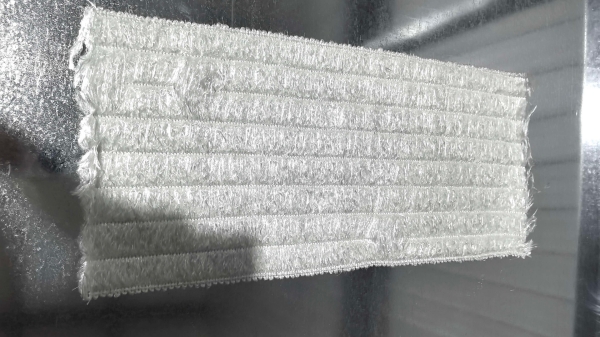
Not necessarily. Silencer wadding, fiberglass packing mat and exhaust packing sheet describe broad material or supply-form categories. Those names alone do not confirm the presence of a heat-released restraint.
For a direct comparison, request the fiber construction, bonding or stitching method, supplied thickness and intended installed condition. A conventional mat may be designed to retain its structure rather than release it.
The continuous filament muffler packing construction described here is intended for acoustic filling inside a suitable silencer. It should not be confused with an external exhaust heat wrap or with expanding foam used for unrelated sealing applications.
Begin with a controlled comparison: identify the fiber grade, installed fiber mass, cavity geometry and any other packing layers. Record differences between the proposed sheet and the existing construction so that a material change is not mistaken for a supply-format change.
Evaluate assembly fit before heating, then inspect the released distribution and retention after the agreed conditioning and duty cycle. Use the same documented acoustic test conditions when comparing silencers. Include pressure-loss measurements where the design validation requires them.
A useful approval record links the accepted result to a specific material, cutting layout, filling weight and drawing revision. Neither the word "expanding" nor a photograph of a full chamber establishes a decibel reduction, a service interval or finished-exhaust compliance.
For drawing- or sample-based development, see the BSTFLEX OEM muffler packing manufacturing service. Distinguish a like-for-like replacement request from a project that changes the fiber, filling quantity or layer arrangement.
No. Specify a heat-released construction rather than assuming that all fiberglass sheets behave this way. Ask how the structure is restrained before installation and what releases it.
A universal multiplier is not an adequate specification. Any stated expansion ratio needs defined starting compression, heating conditions and measurement conditions. Free expansion outside a shell is not the same as release inside a confined packing chamber.
Use the supplier's approved cutting method for the construction. Specify width, cut length and required fiber mass together, and check whether cutting affects the stitching or handling stability.
Use the specified initial arrangement and filling quantity rather than an "as tight as possible" rule. Maintain installation stability without adding restraints that prevent the intended release.
Engine cycle alone does not confirm suitability. Check the fiber grade, chamber geometry, operating conditions, filling quantity and existing silencer requirements for each application.
For an expanding exhaust packing quotation, provide the silencer cross-section, core outside diameter, internal shell dimensions and effective packing length. Include the approved dry fiber mass or existing packing specification, operating temperatures with measurement locations, sample quantity and expected production demand.
Also state whether you require material for in-house cutting or a defined cut component. Identify the preferred packaging, part labeling and dimensional or weight checks needed at goods receipt. Unknown values can be marked for development rather than replaced with assumptions.
Review the BSTFLEX heat-released fiberglass silencer packing sheet as the starting product for your inquiry. Material grade, release behavior and finished specification should be agreed for the intended assembly before production approval.

No.10, Chuangxin North Road, Nanshan Park, Ningguo Economic and Technological Development Zone, Ningguo City, Anhui Province, China
Tel/Whatsapp : 0086-15856303740
Email : sales@bstbraidedsleeve.com
Skype : vanesa-cheng