What are you looking for?
Welding environments create a combination of thermal hazards—sparks and spatter, hot slag, radiant heat, and intermittent flame exposure. These risks can damage nearby hoses and cables, degrade insulation materials, and create safety concerns around work zones. BSTFLEX supplies thermal protection products designed to reduce heat transfer, improve durability, and help protect people and equipment in hot-work environments.
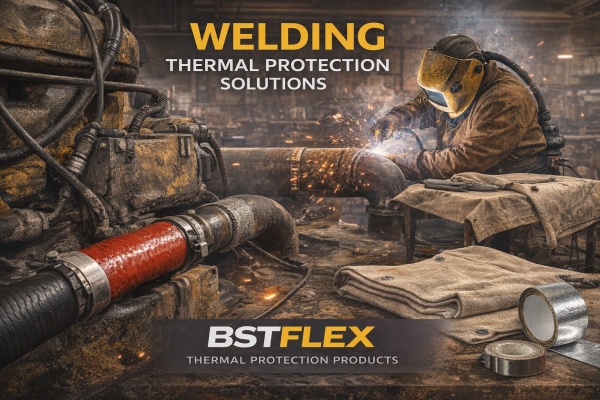
Welding protection is not limited to a blanket on the floor. Many failures occur when heat reaches hoses, wiring, or nearby equipment. Typical protection points include:
For our inspection workflow and batch traceability, review: Quality Guarantee. For certificates and compliance documents, review: Certifications. If you require cut-to-length, shaped parts, or special packaging, review: Custom Capabilities.
To speed up recommendation and quoting, please include the following:
A welding blanket is commonly used for floor protection, covering equipment, or localized shielding. A welding curtain is typically hung to isolate a work area, protect nearby personnel, and reduce exposure to sparks and spatter.
Yes. Welding protection materials are selected to withstand hot particles and reduce the risk of damage to nearby surfaces. For the most effective recommendation, please share the process (MIG/TIG/Stick), intensity, and distance to the hazard.
For hoses and cables exposed to heat and intermittent flame/sparks, fire sleeve solutions are commonly used. Provide hose/cable size and routing constraints so we can recommend the best construction.
Yes. Many installations use a layered approach: a blanket/curtain to shield the work zone, plus heat shield tapes and barriers to protect edges, joints, and localized hot spots.
Yes. We can support documentation packages such as CoC (upon request), agreed inspection reports, and SDS/MSDS where applicable. For details on our controls, see Quality Guarantee and Certifications.
Yes. We support program-specific sizes, cut-to-length formats, and packaging/labeling requirements. See Custom Capabilities and include your requirements in the RFQ.
Tell us your welding process, distance to heat source, spatter intensity, and the items you want to protect. We will recommend the appropriate product family and provide a fast quotation.
Back to Industries: Industries We Serve

No.10, Chuangxin North Road, Nanshan Park, Ningguo Economic and Technological Development Zone, Ningguo City, Anhui Province, China
Tel/Whatsapp : 0086-15856303740
Email : sales@bstbraidedsleeve.com
Skype : vanesa-cheng